
Slopes, swales and channels
Slope & Erosion Control in Salt Lake City, UT
Cover that holds soil on steep, bare ground until roots can take over.
- Free site visits with a written estimate
- Seed mixes chosen for your soil, sun and water
- Seeding scheduled around Salt Lake's spring and late-summer windows
Keeping Hillside Soil Where It Belongs
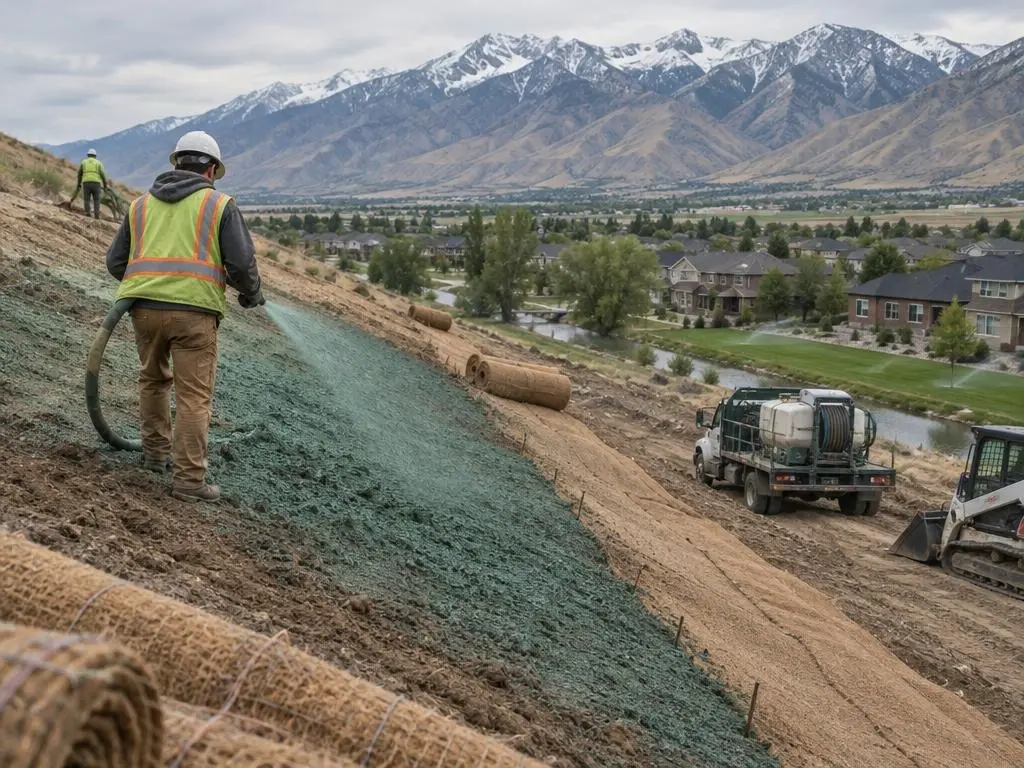
Slope & erosion control is the work of holding bare soil in place on steep ground around Salt Lake City until vegetation can do that job on its own. The valley is ringed by mountains, and many neighborhoods climb onto the old Lake Bonneville terraces along the Wasatch and Oquirrh foothills. When a hillside lot is cut for a house, a retaining wall, a road or a utility, the exposed slope sheds soil with every storm and every windy afternoon. Our erosion control services cover that ground fast with seed plus hydromulch, rolled erosion control blankets or a bonded fiber matrix.
When rain and slope work against you
Airport normals show April as Salt Lake City's wettest month, with about 2.16 inches, and most of the year's precipitation comes with Pacific storms between October and May. In late summer, monsoon thunderstorms are usually scattered, but the ones that do hit can drop a lot of water on a small area quickly. A bare slope that survived a dry July can lose its surface in one August storm. That is why we cover slopes as soon as grading is done instead of waiting for the seeding season.
Hydromulch and hydro mulching
Hydraulic mulch is wood or paper fiber mixed with water, tackifier and usually seed, sprayed onto the slope in a continuous mat. It is fast, follows uneven ground, and needs no one walking on a steep face. On gentle slopes, a standard rate of hydromulch with seed is often enough. As the grade steepens or the runoff above it grows, we increase the rate or move to a heavier product.
Bonded fiber matrix
Bonded fiber matrix (BFM) is a heavier hydraulic product with fiber and binders that form a stronger, more continuous layer once dry. It is used on steeper cut and fill slopes where ordinary hydromulch could slough off, and where blankets would be hard to staple because of rock or the size of the area. It is sprayed in more than one pass to build thickness, and needs dry weather for the binder to set before heavy rain.
Erosion control blankets and straw blankets
Erosion control blankets come in rolls held together by netting and pinned with staples; the fill is straw alone, a straw and coconut fiber blend, or pure coir. They go over seeded soil on slopes, in swales and drainage ditches, and along channels where water flows over the surface. Straw blankets break down within a season or two; coir lasts longer and is used where flow is heavier. The key is installation: the top edge is trenched in, rolls overlap shingle-style, and staples follow the pattern the slope demands. Poorly anchored blankets let water run underneath and do more harm than good.
Swales, ditches and channels
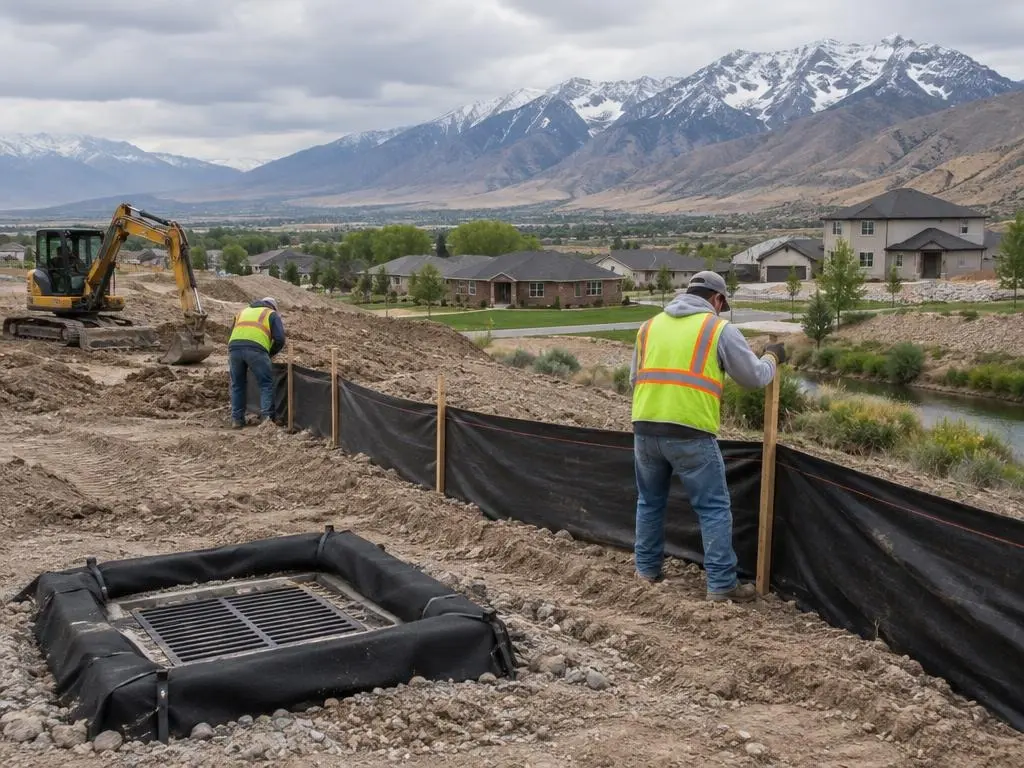
Drainage swales and roadside ditches carry concentrated water, and seed alone will not survive the first runoff. We shape the channel, seed it, and line it with blankets rated for the flow, then tie it into the inlet or outfall so water does not cut around the edge. In the long run, the established grass in the swale filters sediment out of runoff before it reaches a storm drain or one of the creeks feeding the Jordan River.
Choosing a seed for slopes
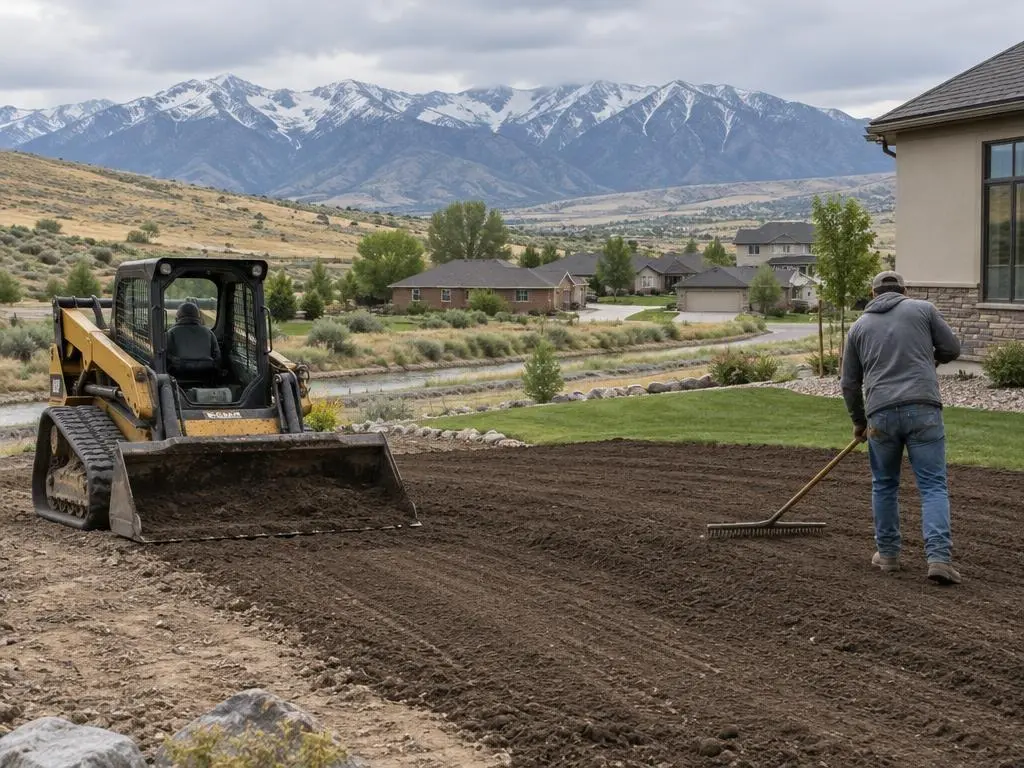
Slopes facing south and west in the valley bake in summer and often have no irrigation. For those, we lean on native and reclamation grass mixes that can live on natural moisture once established, sometimes with wildflowers. Irrigated slopes next to a lawn can take a turf blend. On steep yards, slope stabilization often combines both: turf on the flatter area people use, and native cover on the bank.
Fixing failures
Some of our slope work is repair. Common problems include rills and gullies cut where water from a roof, driveway or neighboring lot runs over the face, blankets that were laid without a top trench and let water underneath, and mulch sprayed too thin on a steep cut. We trace where the water comes from first, divert or pipe it where needed, regrade the damaged section, and then re-cover it with the right product.
What it costs
One state transportation department's January 2025 erosion-control price list puts hydraulic wood mulch at $98 and straw and coconut blankets at $468, both per 1,000 square feet. HomeGuide adds that a steep slope raises residential hydroseeding by $0.05 to $0.10 a square foot. Bonded fiber matrix gets quoted on site, since rate and passes vary. Get a free estimate
Erosion Control Options
The right cover depends on slope, flow and what will grow there.
Hydromulch with seed
Wood fiber mulch, tackifier and seed sprayed in one pass on gentle to moderate slopes.
Bonded fiber matrix (bonded fiber matrix)
A heavier hydraulic layer for steep cut and fill slopes, applied in multiple passes.
Straw and straw-coir blankets
Rolled erosion control blankets stapled over seed on slopes and in swales.
Coir blankets
Longer-lasting coconut fiber blankets for channels and slopes with more flow.
Swale and ditch lining
Shaping, seeding and lining drainage channels so runoff does not cut them.
Slope stabilization planting
Native and reclamation mixes that hold banks without summer watering once established.
Published Erosion Control Prices
| Item | Published price |
|---|---|
| 2025 road-department unit costs: hydromulch (wood fiber), 1,000 sq ft | $98 |
| Same list: blanket of 70/30 straw-coconut, per 1,000 sq ft | $468 |
| Same list: coir-only blanket, per 1,000 sq ft | $532 |
| Same list: hand-spread straw mulch, per 1,000 sq ft | $170 |
| Extra for steep ground on a home hydroseed job, per sq ft (HomeGuide) | $0.05 to $0.10 |
| Bonded fiber matrix | Quoted once we see the slope |
These are averages from cost guides; our written number for your site is final.
How We Stabilize a Slope
1. Read the slope
We look at steepness, length, soil, where water comes from and where it leaves.
2. Pick the cover
Hydromulch, bonded fiber matrix or blankets matched to the slope and flow, with a seed mix for sun and water.
3. Prepare the surface
Track-walk or rough the slope, divert water from above, and fix rills.
4. Apply and anchor
Spray in passes or trench and staple blankets, then tie edges into stable ground.
5. Check after storms
We look for washouts and thin spots and repair them before they grow.
Why Choose Us for Slope & Erosion Control
Product matched to slope
We step up from hydromulch to bonded fiber matrix or blankets as grade and flow demand.
Anchoring done right
Blankets are trenched at the top, overlapped and stapled to pattern.
Water managed first
Runoff from above is diverted so the cover is not fighting a stream.
Slope & Erosion Control Questions
Is hydromulch enough for a steep slope?
On gentle and moderate slopes, often yes. On steeper slopes or where water runs over the face, bonded fiber matrix or blankets hold better.
How long do erosion control blankets last?
Straw blankets are meant to break down as the vegetation takes over, usually within a season or two. Coir lasts longer and is used where flow or slope demands it.
Can you stabilize a slope in summer?
Yes. Cover goes down when grading is done. Seed may wait for moisture, but the mulch or blanket protects the soil in the meantime.
Do I need to water a slope after hydroseeding?
Irrigated slopes should be watered like a new lawn. Non-irrigated slopes are seeded with mixes meant to establish on natural moisture, which is slower.
Slope & Erosion Control Service Areas
- Hydroseeding in Salt Lake City, UT
- Hydroseeding in Herriman, UT
- Hydroseeding in South Jordan, UT
- Hydroseeding in West Jordan, UT
- Hydroseeding in Riverton, UT
- Hydroseeding in Bluffdale, UT
- Hydroseeding in Draper, UT
- Hydroseeding in Sandy, UT
- Hydroseeding in Cottonwood Heights, UT
- Hydroseeding in Holladay, UT
- Hydroseeding in Millcreek, UT
- Hydroseeding in Murray, UT
- Hydroseeding in Midvale, UT
- Hydroseeding in Taylorsville, UT
- Hydroseeding in West Valley City, UT
- Hydroseeding in Kearns, UT
- Hydroseeding in Magna, UT
- Hydroseeding in Tooele, UT
- Hydroseeding in Stansbury Park, UT
- Hydroseeding in Bountiful, UT
- Hydroseeding in Farmington, UT
- Hydroseeding in Centerville, UT
- Hydroseeding in North Salt Lake, UT
- Hydroseeding in South Salt Lake, UT
Get a Slope & Erosion Control Estimate
Free slope assessments in Salt Lake City and the foothill towns.